Writing High Performance SQL For MPP Databases
Massively Parallel Processing (MPP) databases have revolutionized how organizations handle large-scale data analytics. Unlike traditional single-node database systems, MPP architectures distribute computation across multiple nodes, enabling remarkable performance gains for complex analytical queries. However, writing efficient SQL for MPP systems requires understanding their unique execution patterns and optimization strategies.
Understanding MPP Query Execution
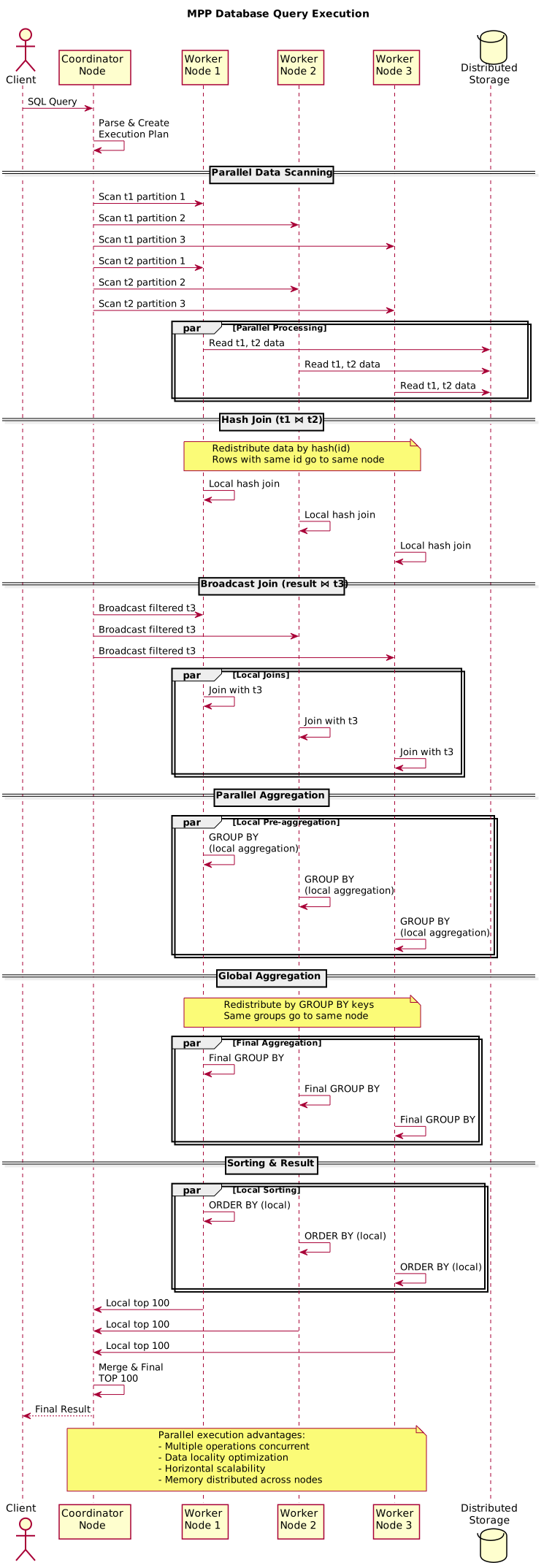
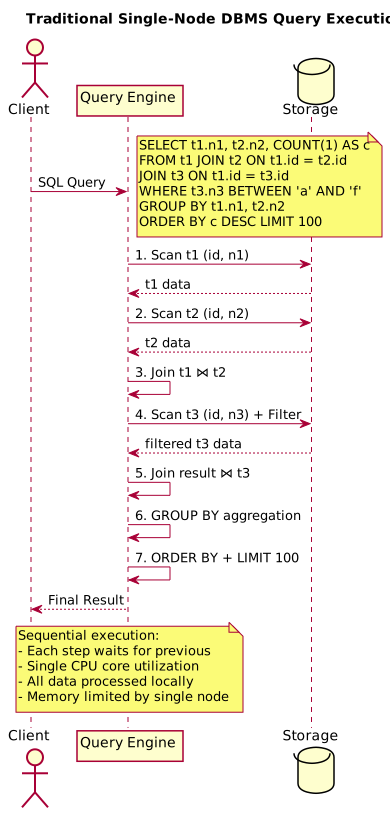
To appreciate the performance benefits of MPP systems, consider how they execute a complex analytical query differently from traditional databases. Take this common analytical query:
SELECT t1.n1, t2.n2, COUNT(1) AS c
FROM t1 JOIN t2 ON t1.id = t2.id
JOIN t3 ON t1.id = t3.id
WHERE t3.n3 BETWEEN 'a' AND 'f'
GROUP BY t1.n1, t2.n2
ORDER BY c DESC
LIMIT 100;
A single-node database executes this query sequentially: scanning tables, performing joins, applying filters, aggregating results, and finally sorting. Each operation waits for the previous one to complete, creating a linear execution path.
MPP systems transform this approach through parallelization. When joining larger tables t1 and t2, the system uses hash joins, distributing rows with identical id values to the same processing nodes. For the smaller table t3, it employs broadcast joins, replicating the filtered data across all nodes. During aggregation, each node performs local grouping operations before redistributing data based on group keys for final aggregation. This parallel approach can reduce query execution time from hours to minutes for large datasets.
Common Performance Bottlenecks
Despite their architectural advantages, MPP systems can experience significant performance degradation under certain conditions. Cluster overload represents the most obvious bottleneck, where resource contention slows all operations. More subtle issues include queue congestion from high-frequency, high-concurrency workloads and poorly written SQL queries that consume excessive resources while delivering low success rates.
Optimization Strategies
Leverage Time Partitioning
The most impactful optimization involves restricting data scans through time partition filters. Without proper filtering, queries scan entire datasets stored in distributed file systems like HDFS:
-- Inefficient: scans entire table
SELECT c1, SUM(c2) AS c2
FROM t1
GROUP BY c1
Adding time partition constraints dramatically reduces the data volume:
-- Optimized: scans only specified date range
SELECT c1, SUM(c2) AS c2
FROM t1
WHERE ds >= 20220901 AND ds <= 20220910
GROUP BY c1
This simple addition can transform a query from scanning terabytes to processing only the relevant subset, often reducing execution time by orders of magnitude.
Select Only Required Columns
The SELECT * pattern, while convenient during development, creates unnecessary overhead in production environments. Consider this example where only specific columns are needed:
-- Inefficient: transfers all columns across the network
SELECT a.date, SUM(b.b1) AS sales
FROM (
    SELECT * FROM t1 WHERE ds = 20220901
) a
JOIN (
    SELECT * FROM t2 WHERE ds = 20220901
) b
ON a.date = b.date
GROUP BY a.date
Specifying only required columns reduces network traffic and memory consumption:
-- Optimized: transfers only necessary data
SELECT a.date, SUM(b.b1) AS sales
FROM (
    SELECT date FROM t1 WHERE ds = 20220901
) a
JOIN (
    SELECT date, b1 FROM t2 WHERE ds = 20220901
) b
ON a.date = b.date
GROUP BY a.date
Apply Filters Early
Filter placement significantly impacts query performance in distributed systems. Applying filters after joins forces unnecessary data movement across the network:
-- Inefficient: filter applied after join
SELECT a.date, SUM(b.b1) AS sales
FROM (
    SELECT date FROM t1 WHERE ds = 20220901
) a
JOIN (
    SELECT date, b1 FROM t2 WHERE ds = 20220901
) b
ON a.date = b.date
WHERE b.b1 >= 100
GROUP BY a.date
Moving filters closer to data sources reduces the amount of data transferred and processed:
-- Optimized: filter applied before join
SELECT a.date, SUM(b.b1) AS sales
FROM (
    SELECT date FROM t1 WHERE ds = 20220901
) a
JOIN (
    SELECT date, b1
    FROM t2
    WHERE ds = 20220901 AND b1 >= 100
) b
ON a.date = b.date
GROUP BY a.date
Advanced Optimization Techniques
Aggregate Before Joining
One of the most effective optimizations involves reducing data volume before expensive join operations. Instead of joining full tables and then aggregating, perform aggregations first to minimize the data that needs to be redistributed across nodes.
-- Inefficient: join large tables, then aggregate
SELECT u.region, p.category, SUM(o.amount) AS total_sales
FROM users u
JOIN orders o ON u.user_id = o.user_id
JOIN products p ON o.product_id = p.product_id
WHERE o.order_date >= '2022-01-01'
GROUP BY u.region, p.category
-- Optimized: aggregate orders first, then join the smaller result set
SELECT u.region, p.category, agg.total_amount AS total_sales
FROM (
    SELECT user_id, product_id, SUM(amount) AS total_amount
    FROM orders
    WHERE order_date >= '2022-01-01'
    GROUP BY user_id, product_id
) agg
JOIN users u ON agg.user_id = u.user_id
JOIN products p ON agg.product_id = p.product_id
GROUP BY u.region, p.category
This approach can reduce join complexity from millions of order records to thousands of aggregated records.
Replace Joins with Unions When Appropriate
In scenarios where data can be combined rather than related, unions often perform better than joins by eliminating complex data redistribution patterns.
-- Less efficient: joining tables with a similar structure
SELECT 'current' AS period, region, SUM(sales) AS total
FROM current_sales
WHERE date_key >= 20220101
UNION ALL
SELECT 'previous' AS period, region, SUM(sales) AS total
FROM previous_sales
WHERE date_key >= 20210101 AND date_key < 20220101
GROUP BY period, region
This pattern works particularly well when combining historical data with current data for trend analysis.
Avoid Cartesian Products
Cartesian products occur when join conditions are missing or inadequate, causing every row from one table to match every row from another. This creates exponentially large intermediate results that can crash queries or consume entire cluster resources.
-- Dangerous: missing join condition creates Cartesian product
SELECT c.customer_name, p.product_name
FROM customers c, products p
WHERE c.region = 'US'  -- Missing join condition!
-- Safe: proper join condition
SELECT c.customer_name, p.product_name
FROM customers c
JOIN order_items oi ON c.customer_id = oi.customer_id
JOIN products p ON oi.product_id = p.product_id
WHERE c.region = 'US'
Optimize DISTINCT Operations with GROUP BY
The DISTINCT operation can be computationally expensive, especially on large datasets. Using GROUP BY before DISTINCT operations allows the database engine to eliminate duplicates more efficiently during the aggregation phase.
-- Less efficient: DISTINCT on a large result set
SELECT DISTINCT user_id, region
FROM user_activities
WHERE activity_date >= '2022-01-01'
-- More efficient: GROUP BY eliminates duplicates during aggregation
SELECT user_id, region
FROM user_activities
WHERE activity_date >= '2022-01-01'
GROUP BY user_id, region
For counting distinct values, consider using approximation functions when exact counts aren’t required:
-- Exact but expensive
SELECT COUNT(DISTINCT user_id) FROM large_table

-- Approximate but fast (HyperLogLog algorithm)
SELECT APPROX_COUNT_DISTINCT(user_id) FROM large_table
Handle Data Skew and Anomalies
Data skew occurs when certain partition keys contain disproportionately more data than others, causing some nodes to work much harder than others. This imbalance can make the entire query wait for the slowest node to complete.
Common causes of data skew include:
- Popular products or users that generate significantly more activity
- Date partitions where certain days have unusually high activity
- Geographic regions with concentrated user bases
To identify skewed data:
-- Check data distribution across partitions
SELECT partition_key, COUNT(*) AS row_count
FROM large_table
GROUP BY partition_key
ORDER BY row_count DESC
LIMIT 10
Mitigation strategies include filtering out known problematic values or using alternative partitioning schemes:
-- Filter out anomalous data that causes skew
SELECT user_id, SUM(activity_count) AS total_activity
FROM user_activities
WHERE user_id NOT IN (
    SELECT user_id
    FROM power_users
    WHERE activity_count > 1000000
)
GROUP BY user_id
Strategic Use of LIMIT
Adding LIMIT clauses serves multiple optimization purposes beyond just reducing the result set size. It allows the query optimizer to use more efficient execution strategies, particularly for TOP-N queries.
-- Optimizer can use more efficient algorithms for limited results
SELECT customer_id, total_purchases
FROM customer_summary
ORDER BY total_purchases DESC
LIMIT 100
For pagination scenarios, consider using range-based filtering instead of OFFSET, which can be expensive:
-- Inefficient for large offsets
SELECT * FROM transactions ORDER BY transaction_id LIMIT 100 OFFSET 10000

-- More efficient range-based approach
SELECT * FROM transactions
WHERE transaction_id > 10000
ORDER BY transaction_id
LIMIT 100
Merge and Deduplication Strategies
When dealing with incremental data loads or multiple data sources, efficient merge and deduplication operations become critical. Using window functions can often outperform traditional approaches:
-- Efficient deduplication using window functions
SELECT user_id, activity_date, activity_type, activity_count
FROM (
    SELECT user_id, activity_date, activity_type, activity_count,
           ROW_NUMBER() OVER (
               PARTITION BY user_id, activity_date
               ORDER BY last_updated DESC
           ) AS rn
    FROM user_activities
) ranked
WHERE rn = 1
This approach is particularly effective for maintaining slowly changing dimension tables or handling late-arriving data in data warehouse environments.
Conclusion
Effective SQL optimization for MPP databases centers on minimizing data movement and maximizing parallel processing. The strategies covered—from partition filtering to advanced aggregation techniques—provide a practical foundation for high-performance analytical queries. Success comes through iterative refinement guided by execution plans and performance metrics, enabling organizations to fully leverage MPP capabilities for large-scale analytics.