How We Improved User Satisfaction From 3.8 To 4.5
When product usage scales from thousands to over 200,000 daily active users, user feedback volume grows exponentially. What starts as manageable manual tracking quickly becomes overwhelming noise. This article explores how developing a Custom Experience Management (CEM) system transformed user satisfaction metrics from 3.8/5.0 to 4.5/5.0 within one year.
Problem Came with Scaling
Managing user feedback at enterprise scale presents unique challenges. With over 200,000 daily active users, the feedback volume reached unmanageable levels. Three critical issues emerged:
- Manual tracking of thousands of feedback submissions became impossible, leading to delayed responses and lost insights.
- Users experienced dissatisfaction when their feedback appeared to disappear without acknowledgment, even after requested features were implemented.
- No existing solution could aggregate feedback from multiple sources while maintaining automatic synchronization with project management workflows.
System Architecture
The solution involved building a comprehensive feedback management system that integrated seamlessly with existing infrastructure.
Core Operations Framework
The system architecture centered around several key operational domains:
Feedback Management: Essential data operations including querying with pagination, detailed feedback retrieval, submission handling, updates, and deletion capabilities. Additionally, reply functionality enabled direct communication with users, while corporation member search functionality facilitated proper assignment and notification workflows.
Project Integration: Seamless integration with the project management system allowed automatic story creation, querying, and binding feedback to development tasks. This eliminated the disconnect between user requests and development workflows.
Administrative Controls: Administrative functions included CSV import capabilities for bulk data operations, permission verification systems, and frontend configuration management to ensure proper access control.
Data-Driven Decision Making
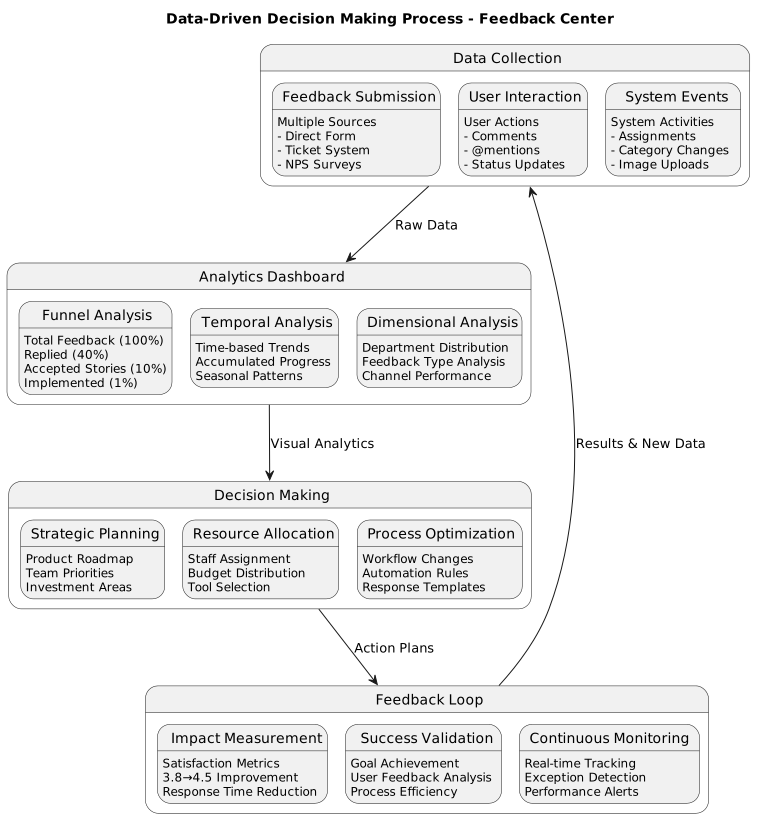
The system’s value extends beyond feedback collection to a complete data-driven process that transforms raw feedback into actionable business outcomes.
Data Collection and Processing
The foundation begins with comprehensive data collection from multiple sources: direct form submissions, ticket systems, NPS surveys, user interactions, and system events. Real-time aggregation processes this raw data alongside batch analytics for historical analysis, calculating key metrics like conversion rates and user satisfaction scores.
Analytics Dashboard
The analytics layer provides three critical analysis dimensions:
Funnel Analysis: Conversion tracking provides clear visibility into feedback lifecycle efficiency. The system monitors total feedback volume (baseline 100%), response rates (achieved 40%), acceptance rates for user stories (reached 10%), and implementation rates (achieved 1%). These metrics revealed bottlenecks in the feedback-to-feature pipeline.
Temporal Analysis: Time-based analytics display metric trends over different periods, accumulated progress tracking, and aggregation capabilities by day, week, or month. This temporal view enabled identification of seasonal patterns and process improvement opportunities.
Dimensional Analysis: Multi-dimensional drill-down capabilities examine metric distribution across departments, feedback types, and channels. Temporal distribution analysis answers questions like “which department receives the most feedback” and “when did specific trends emerge.”
Insight Generation and Decision Making
Dashboard analytics enable identification of user behavior trends, peak activity times, and common issues through visual data analysis. Teams can identify bottlenecks in process delays and resource constraints, while discovering opportunities through feature requests and user experience gaps revealed in the feedback data.
These insights drive strategic planning for product roadmaps, resource allocation for staff and budget distribution, and process optimization through workflow changes and automation rules.
Action Implementation and Feedback Loop
Decisions translate into system updates, process changes, and team notifications through the daily push system. The crucial feedback loop measures impact through satisfaction metrics (demonstrating the 3.8→4.5 improvement), validates success against goals, and maintains continuous monitoring for real-time performance tracking.
This complete cycle ensures that every piece of feedback data contributes to measurable business outcomes and continuous system improvement.
Automated Workflow Integration
The system’s strength lies in automation that reduces manual overhead while maintaining human oversight.
Core Operations Framework
The system architecture centered around several key operational domains:
Feedback Management: Essential data operations including querying with pagination, detailed feedback retrieval, submission handling, updates, and deletion capabilities. Additionally, reply functionality enabled direct communication with users, while corporation member search functionality facilitated proper assignment and notification workflows.
Project Integration: Seamless integration with the project management system allowed automatic story creation, querying, and binding feedback to development tasks. This eliminated the disconnect between user requests and development workflows.
Administrative Controls: Administrative functions included CSV import capabilities for bulk data operations, permission verification systems, and frontend configuration management to ensure proper access control.
Push Notification System
Recognizing that technology alone cannot ensure user satisfaction, the system includes a daily push mechanism that notifies team members of pending feedback requiring attention. This human-in-the-loop approach ensures no feedback falls through organizational cracks.
Security Implementation
Administrative functions require permission verification, while user operations utilize access token authentication. This dual-layer approach balances security with usability.
Impact and Results
Within one year of deployment, the system demonstrated measurable improvements:
Volume Management: Successfully processed over 3,000 user feedback submissions with automated tracking and categorization.
User Satisfaction: Improved user satisfaction metrics from 3.8/5.0 to 4.5/5.0, indicating enhanced user experience.
Organizational Adoption: Three additional internal platforms integrated the system, demonstrating its effectiveness and reusability.
Process Efficiency: Automated project management integration eliminated manual story creation and tracking overhead.
Technical Implementation Notes
The backend implementation utilized Java for robust enterprise-scale performance, while frontend development was handled by a dedicated frontend developer. The modular architecture enabled rapid feature development and easy integration with existing Tencent infrastructure.
Database optimization focused on efficient querying with proper indexing on feedback_id relationships. The schema design supports horizontal scaling as feedback volume continues growing.

Database Architecture
The database design prioritized scalability and relationship management across multiple entity types.
The primary t_feedback table stores essential feedback information including content, status, type, creation timestamps, user information, and business line associations. Status tracking supports multiple states: pending, following, and solved. Feedback classification includes stories, inquiries, and bugs.
Supporting tables handle specialized functionality. Image management occurs through t_feedback_image, storing COS (Cloud Object Storage) links and associating images with either feedback entries or comments. Category management utilizes t_feedback_category to link business-specific categories like ‘ovb_special’ and ‘news_special’ to feedback entries.
User interaction features rely on t_feedback_comment for comment storage, supporting nested parent-child relationships and @mention functionality. The t_feedback_user table maintains comprehensive user profiles including organization structure and business line associations.
Assignment management leverages t_feedback_owner for ownership tracking and t_feedback_recipient for notification management. All tables connect through feedback_id relationships, enabling complex queries while maintaining data integrity.
Conclusion
Effective enterprise feedback management requires balancing automation with human oversight, metrics-driven development, and seamless workflow integration. The Custom Experience Management system demonstrated this approach, improving user satisfaction from 3.8 to 4.5 while processing over 3,000 submissions and expanding to three platforms.
For organizations facing similar scaling challenges, comprehensive feedback infrastructure that enhances existing workflows provides sustainable competitive advantage.